
 Pacta sunt servanda!
Strategic management is the art of analytical thinking and making business decisions aimed at optimal use of the company’s resources to achieve market success and build its sustainable competitive advantage. This is an art that can be critical to master in times of economic downturn and the need to drastically reduce operating costs.
The origin of the word “strategy” dates back to ancient Greece. It defines the rules of warfare, i.e. the method of setting military objectives, deploying troops and military equipment, and conducting military campaigns. Today, the word “strategy” has also become very popular in the business sphere.
Without going into a detailed analysis of the definitions provided by various dictionaries, we can say that strategy is rational planning and resource allocation that focuses on the most important issues related to the company’s development, sets clear measurable goals and precisely defined action plans. The most important question around which the issue of strategic management focuses is the question of:
How should the limited resources available to the company be used
to provide a product or service of appropriate quality to the client
and thus achieve all financial and non-financial
goals of the company?
The most important strategic goal of the company is to maintain its constant development in the long term. We can say that the “strategy” is a kind of “road map” or “game plan” in a competitive business environment – a game in which the role of the market leader is at stake. The basic elements of this game are:
- the field of competitive struggle, i.e. the sector, industry and market in which the company operates,
- the needs of customers, on which the company should constantly focus its attention,
- manufactured products and services that should meet customer expectations as best as possible.
Strategic planning (the first stage of the strategic management process) is a task performed on the highest managerial level. Typical questions that arise at the stage of preparing a strategic plan are questions about:
What products and in what quantity should be produced to exactly meet the demand?
How and where to locate production and what actual production efficiency do we need and what resources do we need?
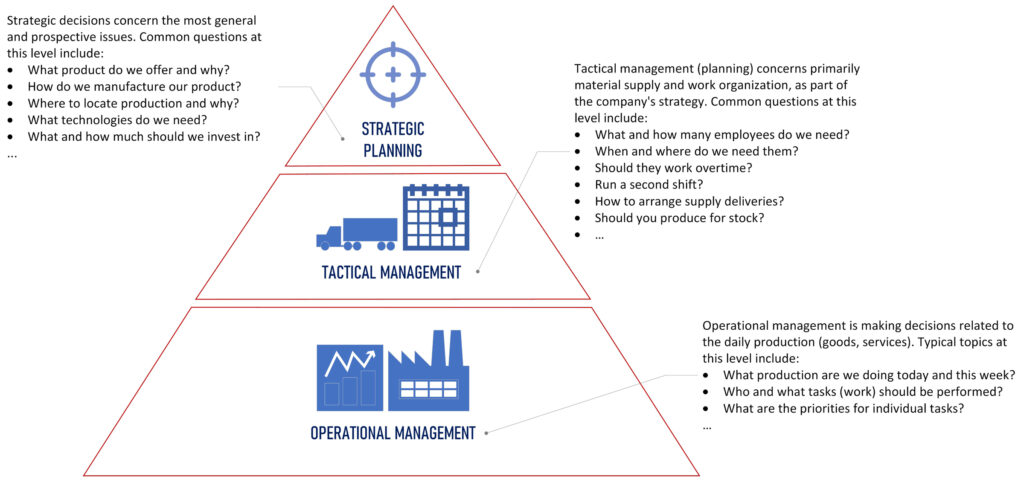
The answers to these and other similar questions determine the scope of strategic planning, the time horizon of which determines the nature and speed of changes taking place in a given industry.
The level of tactical management is the level at which senior and middle management staff design action plans necessary to achieve the company’s strategic goals. This is the level of project planning and task budgeting. Decisions of a tactical nature are the basis for making detailed decisions at the operational level. Operational decisions are decisions made in the perspective of the day and the next week. They concern the division of tasks and setting priorities for their implementation.
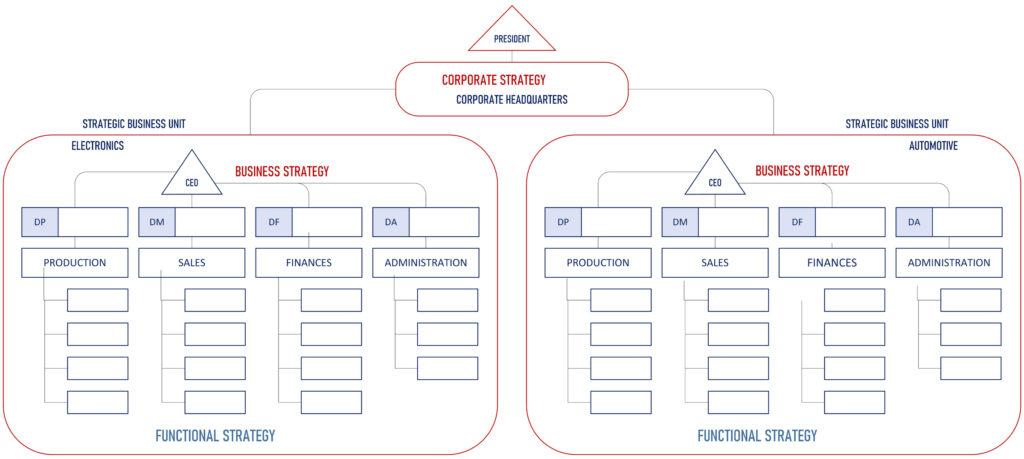
The strategic management process includes three basic phases: (1) analytical phase, (2) strategic planning phase and (3) strategy implementation and monitoring phase. The beginning of this process is the stage of defining or updating the vision of development and the mission of the enterprise. The next stage is the formulation of strategic goals, based on the results of analyzes of the company’s external environment and its internal development conditions. The next stages are: designing strategic action plans, allocating resources, implementing the established plans and monitoring the effects of their implementation on an ongoing basis. In large companies (corporations, groups of companies), strategic management is carried out at three basic levels: at the corporate level, at the level of each business unit and (3) at the functional level.
Starting to implement the strategic management process, many organizations ask themselves whether to do it on their own or with the help of external consultants? Each variant has its advantages and disadvantages. The preparation of a good strategy requires the knowledge of appropriate methodological solutions and time, i.e. attributes that are often lacking in an enterprise due to the dominance of operational tasks over strategic projects. The strategy prepared by external consultants may, however, be characterized by objectivity and professionalism, but there is also a risk of its limited practical usefulness due to the lack of reflection of views and approval from the top management.
The best solution is to build a strategy with the strong involvement of the company’s management staff, supported by external consultants. This approach gives the best chance of developing a realistic, strategic plan of action and is the cheapest. An additional synergistic effect of adopting such a solution is the improvement of internal communication and skills in planning and implementing the strategy. However, it requires time, committed leadership of leaders and managerial skills at every level of management.
Defining the company’s business model
The first question you should ask yourself when starting strategic planning is the question of the sense of the company’s activity, i.e. the question of who it is intended to serve? Is it primarily its owners to make money? Or the customers who use its products and services?
Of course, both, but the existence of the company has a much wider impact on a group of numerous people and institutions, which are called the company’s stakeholders. The company’s stakeholders can be divided into two main groups: (1) company owners and employees, and (2) customers and all other external entities for whom the company’s existence is of any importance. Stakeholders’ expectations towards the company (sometimes contradictory) are of fundamental importance in the context of building the company’s operating strategy and development.
When thinking about the company’s business model, or in other words – the formula of its operation – three basic questions should be asked:
What type of need does the company meet?
So, in what sector and on what market does it operate?
Whose needs does the company meet?
So, what is its product portfolio and to which customer groups are they delivered?
How are the needs of the company’s customers met?
So, what competences, knowledge and technology should it have?
The basic relationship between a company and its customers is determined by the law of supply and demand. Customers, who can be grouped into various market segments, generate demand for specific material goods or services. In response to demand, the company offers a number of products or services, which are grouped into so-called product portfolios. Sometimes product portfolios have a distinctive brand or sub-brand. In the financial sector, we can talk about business segments. In each case, the basis for separating a portfolio of services or a segment of activity is the market segmentation adopted by the company, based on the specific needs and characteristic attributes of a specific group of customers.
Business models and work processes
A ‘work process’, also known as a ‘business process’, is a set of activities that transforms an input value into an output value. In turn, the “business model” of each company, i.e. the formula of its operation, is a number of interrelated processes and sub-processes. Work processes. also called “transformation processes”, can be of various nature. Depending on the company’s operating model, these can be activities that involve physical, locational, transactional transformations, storing things, shaping physiological processes, or sending information. All work processes, regardless of their nature, have four basic characteristics:
- Input values,
- Output values,
- Guiding values and
- Enables, factors enabling the process to run according to specific rules.
A company’s business model typically consists of about ten core work processes. They are then divided into subprocesses, activities and tasks. The basic features that a properly described business process should have are:
- Identified process owner,
- Identified supplier of input values and recipient of output values,
- Prepared process documentation,
- Fixed process control points,
- Established problem areas,
- Established measures of effectiveness and efficiency of the process, and
- Feedback mechanisms.
When mapping business processes, the ability to graphically present the course of the process is of elementary importance.
Formulating strategic goals
Setting strategic goals begins at the stage of formulating or updating the company’s development vision and mission statement, the content of which determines the most important directions of action, defines market goals, indicates the company’s distinguishing features and measures of success. The declaration of the development vision and mission is a description of the company’s “dream of the future” and the road it must travel to make this dream come true.

A clear mission statement, referring to tradition, referring to corporate culture, values and presenting a clear marketing strategy, is presented by Mercedes-Benz. An interesting example of a carefully prepared mission statement and development vision is also the declaration of the international financial corporation Allianz. In addition to the scope of the company’s activities, it also points to non-business values, such as corporate social responsibility and care for environmental protection.
The main strategic goals of the company should be derived from the postulates and values expressed in the declaration of development vision and mission. The main goals should then be broken down into operational goals and broken down into appropriate strategic action plans. The declaration of vision and mission is the basis for four main strategic goals, which in turn are described by appropriate action plans, formulated at the corporate, business and functional level of the company.
Regardless of the size of the company and the sector in which it operates, the structure of the basic strategic goals is as follows: The most important goal is the satisfaction of the company’s owners; in order to achieve it, the management board of the company must care for the highest rate of return on long-term investments made from the company’s operating profit. In turn, in order to achieve the highest possible operating profit, it is necessary to care for the needs of customers as much as possible.
When formulating strategic goals, it is important to remember that they should meet the requirements contained in the SMART principle, i.e. they should be: simple, measurable, achievable, realistic and precisely time-oriented. If the goals are NOT specific and provided with appropriate measures (so-called KPIs), it will be difficult to determine whether they are being implemented.
Company operational metrics
Effective company management is not possible without constant control of a specific set of measures used to monitor the effects of operating activities. One of the basic principles of management is:
What cannot be measured cannot be managed!
Therefore, strategic goals must be described with appropriate measures. A well-designed system of measures of operational activity (Key Performance Indicators) sets standards for measuring the quality and effectiveness of the company’s operation and allows for comparison to other similar companies operating in the same industry.
One of the most popular financial measures showing the level of operational efficiency of a company is the EBIDTA indicator, i.e. the level of generated operating profit before tax and deduction of depreciation and loan installments. It can be expressed as an amount or as a percentage of the total value of revenues obtained by the company in a specific time unit.
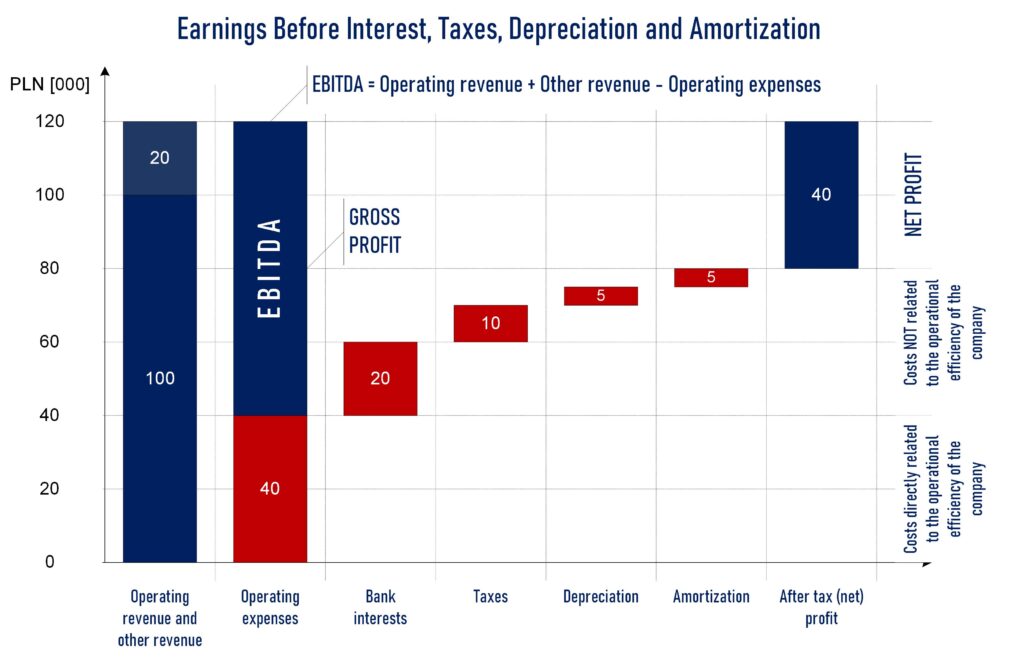
The company’s operational performance metrics can be compared to the metrics an aircraft pilot must constantly monitor to keep it on course. Similarly, the management of the company must constantly control the indicators of operational activity in order to successfully develop its business, raising its competitive position to an ever-higher level.
Operational indicators can be divided into different groups. These may be measures characterizing the company’s operational efficiency, measures used to determine the company’s competitive position in the sector or indicators characterizing the market situation.
Formulation of strategic action plans and project management
Strategic action plans can be divided into two basic groups: (1) action plans of a one-time nature and (2) action plans of a repeatable nature. Depending on the established strategic goal, they may take the form of, for example, a repeatable standard operating procedure or a project.
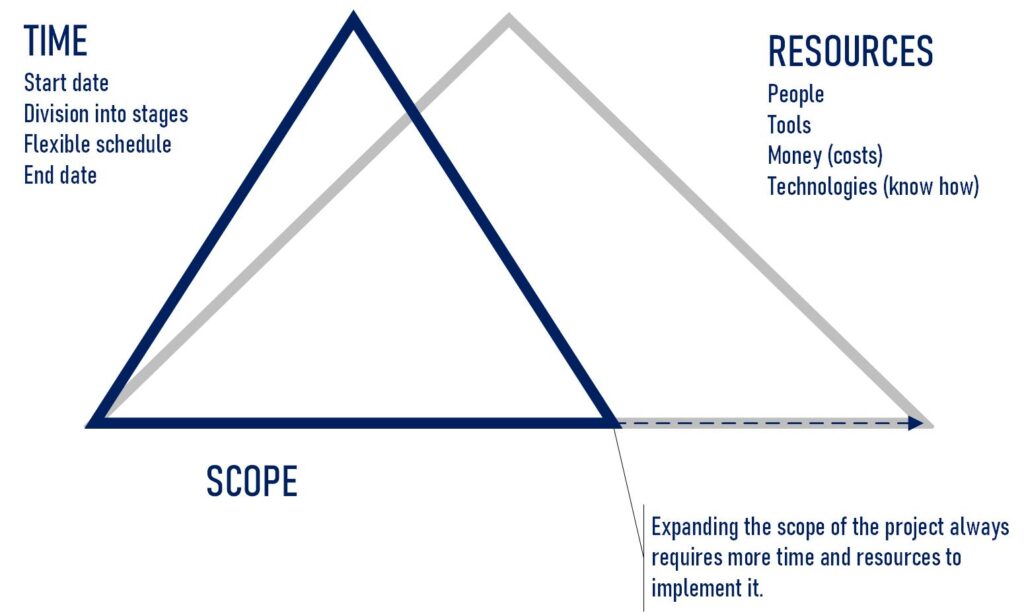
A project is the form in which strategic action plans are most often implemented – even when its effect will be regulations or a standard operating procedure. The three basic dimensions that characterize each project are the goals, the time of its implementation and the resources necessary for it. It is worth emphasizing that increasing the scope of the project automatically forces an increase in resources and the amount of time needed for its implementation.
A project undertaking can be organized in a functional arrangement – when the sponsor, project manager and the entire project team consist of employees of one organizational division or department, or in a matrix arrangement. A project in a matrix system is one that involves employees of several organizational divisions or departments. Matrix projects are typical of strategic projects, including new product development procedures.
The proper organization of the project team is of great importance for the success of the project. The structure of such a team should include representatives of three parties: (1) the project owner, (2) the user of the project’s products, and (3) the supplier of the product being the result of the project. The right selection of people, the size of the team and a properly prepared project plan are the basic conditions for the success of such an undertaking.
The most popular in the sphere of business and public administration are two model methodological solutions for project management. The first model is an American methodology developed by the Project Management Institute under the name Book Of Knowledge (PM BOK); the second is a methodology developed by the UK government called Project In Controlled Environment (PRINCE2).
The main stages of project implementation in both methodologies are similar. These are: the project initiation, planning, execution and closing phases. However, they differ in their methodological approach. The PMI methodology to a greater extent focuses on the ways of implementing project tasks, such as, for example, calculating critical paths of task implementation, while PRINCE2 focuses more on the issues of the project procedure. The individual tasks of the project manager are described in detail in this methodology for each phase of its implementation.
Strategic analysis
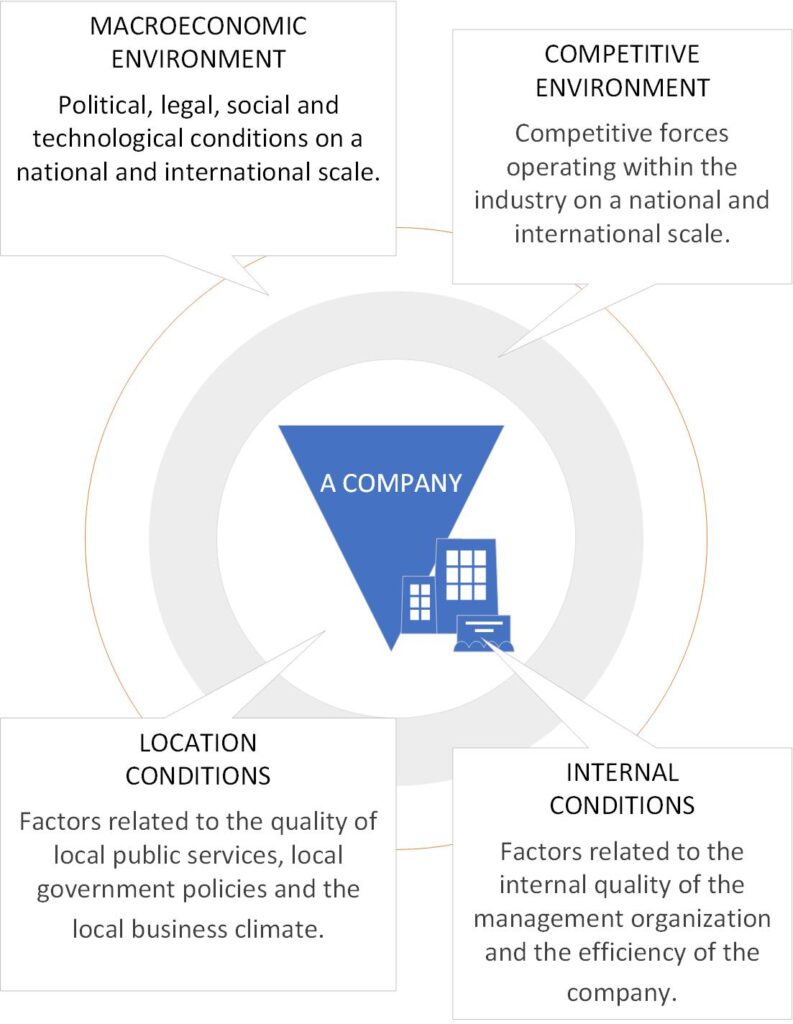
As in the natural environment, also in the business environment, those companies that are best able to adapt to changing environmental conditions have the best chance of survival. The company’s ability to determine the right development strategy depends primarily on the ability to recognize the changes taking place in its environment, i.e. the ability to conduct various strategic analyses.
Changes in the competitive environment of the company may be characterized by diverse dynamics depending on the industry, regulatory conditions or the pace of technological change. An example of a stable business environment can be the sector of food producers, while turbulent changes can be observed in the rapidly developing sector of modern communication technologies.
In the environment of each company, we can distinguish two main environments. The first is the macroeconomic environment, in which factors of a political and legal, economic, social and technological nature are distinguished. The second sphere is the competitive environment of the company. There are five main groups of factors related to the bargaining power of customers, suppliers, product substitutes, new players in the industry and the intensity of competition between companies operating in the industry.
Corporate, business and functional strategies
The theory and practice of strategic management indicate that in most companies two basic types of strategic plans can be distinguished – strategies formulated at the corporate level and strategies formulated at the level of business units. A separate – third group – are strategies formulated at the functional level of the company.
Corporate strategy establishes action plans whose most important goal is to ensure the long-term development of a company or group of companies. Strategies formulated at the business unit level are activities aimed at ensuring the advantage of a single company (unit profit generating center) over its competitors.
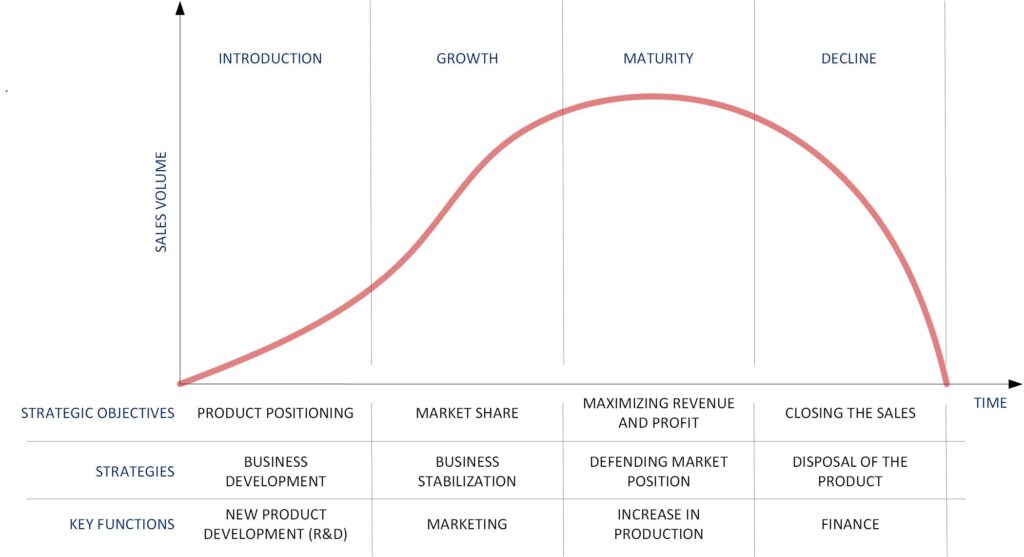
The basic concept used when formulating strategies at the corporate and business level is the Product Life Cycle (PLC) concept, the principles of which are applied analogously to product life cycle management. Each strategic business unit (or product) has four basic stages of its life – market entry, growth, maturity and exit from the market.
An example of a corporate strategy is the expansion into new groups of T-Mobile, which in recent years has expanded its operations in Central Europe, taking control of local mobile network operators through acquisitions. Another example is the structured ownership structure in the Allianz Group.
Strategies at the business unit level are basically two directions of market activities: (1) product quality dominance strategy or (2) price dominance strategy. In the first case, the company focuses on offering the highest quality products for demanding and affluent customers. In the second, he strives to sell as much of the cheap product as possible, which has a minimum acceptable level of quality. In practice, mixed models of strategic activities are used.
Strategies at the functional level are those activities aimed at increasing the efficiency of the company’s operations, increasing the quality of the product and implementing innovative technologies and achieving the highest possible level of interest from customers.
Managing change
Formulating a new company strategy may require various changes in the way it functions. These may include changes to the location of the company, the technologies used, partnerships, internal policies, as well as changes in the organizational structure. Organizational changes are usually given the highest priority of implementation.
Developing and transforming the organizational structure consists in grouping tasks, functions and creating appropriate organizational units. The limits within which it is possible to rationally shape the organizational structure are determined by two basic parameters: (1) the maximum scope of management and (2) the minimum command chain. They determine to the greatest extent the possibility of “flattening” the structure.
The organization of the company’s operation on an international scale involves decisions regarding the basic formula of its operation, i.e. the method of organizing supplies, production, distribution, marketing, research activities and the implementation of many other tasks. These are decisions made in the sphere of the company’s functional strategy and implemented at the corporate level.
Introducing changes always causes anxiety among employees about their professional situation. The typical psychological response to change can be divided into five basic phases: (1) anger, (2) denial, (3) bargaining, (4) depression, and (5) acceptance of the new situation. The length and course of this psychological cycle varies from situation to situation.
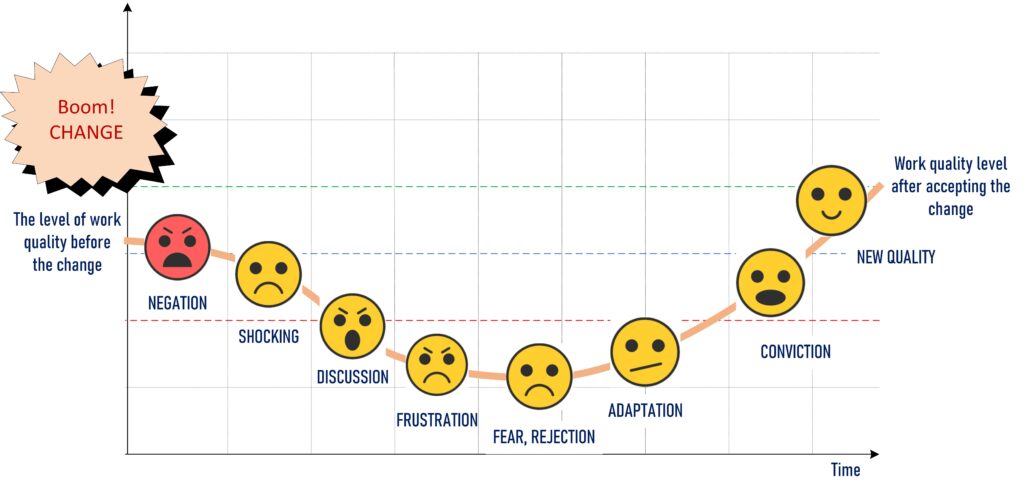
Effective change management requires responsible involvement of leaders, clear information, training, motivating and direct involvement of employees in changes. Communication is the element of management that is of primary importance both in the context of introducing strategic changes and shaping the right corporate culture in the company. The content of the message, its form and distribution channels, as well as the time and frequency of dissemination are important.
Tomasz Domański
© All rights reserved.
Copying without the author’s consent is prohibited.
Please contact contact me if needed.
