Pacta sunt servanda!
A legal provision is a grammatically correct, logical sentence, which is the basic unit of a normative act (acts, regulations, resolutions). It can be a separate sentence, article or paragraph. It may contain a complete legal norm or be only a part of it. Legal norms can be built from the submission of more provisions (derived from one or more acts).
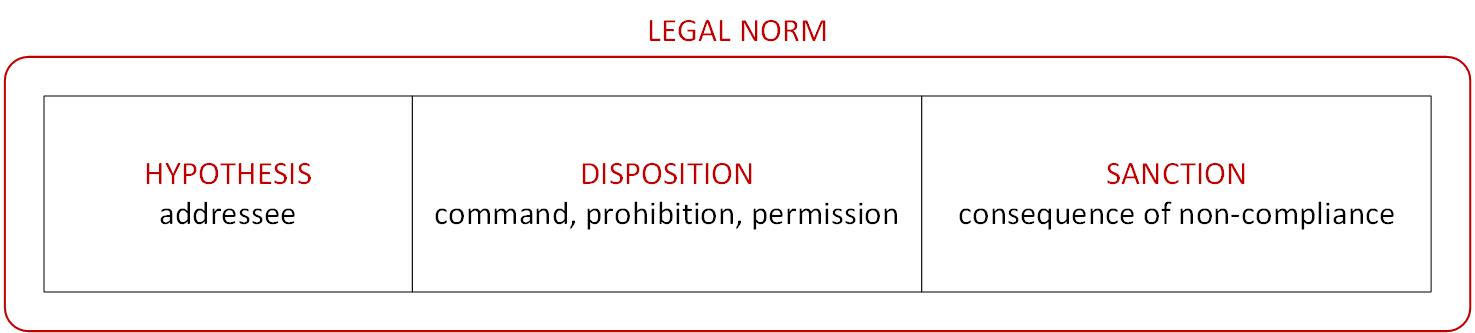
A legal norm is a pattern of required behavior or omission in certain circumstances (order, prohibition or permission). It can be contained in the content of a single legal provision, or it can be composed of a number of provisions relating to a specific situation. A legal norm consists of three basic parts: hypothesis, disposition and sanction. The hypothesis indicates the addressee of the legal norm. It can be addressed to everyone, or to selected groups of people, or to an individually defined addressee. The disposition orders the addressee to take a specific action or to refrain from acting. The sanction, on the other hand, informs about the consequences of non-compliance with the disposition of the legal norm.
Law, which is a set of rules of behavior in certain circumstances, can be divided into three main categories: natural law, customary law, and statutory law. Consistency between these categories is one of the basic features of a good, servile to people, system of law.
Natural law is the group of moral norms that are the basis of human dignity and freedom. It reflects the natural aspiration of man to truth, justice, good and beauty. It is an objectively existing part of the reality that surrounds us, just like the laws of physics. However, unlike the immutable laws of physics, moral orders and prohibitions can be broken by humans, what leads to conflicts, suffering and chaos. A formal set of fundamental norms of natural law is, among others, the Decalogue.
Customary law is a pattern of behavior established in the traditions of smaller and larger communities. It does not come from legislative bodies, but is passed down from generation to generation in the form of local customs. It is sometimes confirmed in the form of formalized legal acts. It is an intermediary between natural law and statutory law.
Statutory law is passed by authorized legislative bodies. It takes the form of laws, resolutions, ordinances and acts of local law. It should be a specification of the principles arising from natural and customary law. It is at the top of the hierarchy of the legal system built on the foundation of natural and customary law. A good system of statutory law should be consistent with natural law, complete, clear, internally consistent, stable and properly announced.
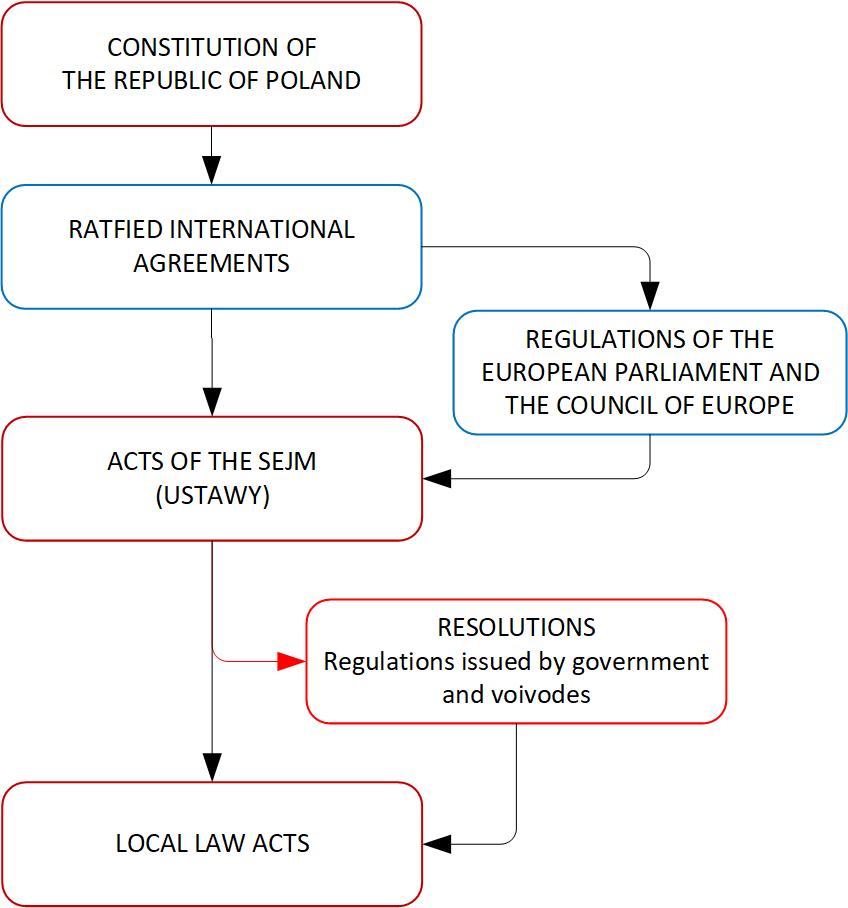
The Constitution of the Republic of Poland is the highest legal act in the Polish legal system (the Basic Law). Its provisions are directly applicable, unless it provides otherwise. All laws and other sources of law must comply with the Constitution of the Republic of Poland. The Basic Law defines the basic rules for the functioning of the state.
The Act is the basic act of establishing universally binding law. The law is passed by the Sejm and the Senate of the Republic of Poland, in accordance with the principles set out in the Constitution of the Republic of Poland. The bill passed by the Parliament is presented by the Marshal of the Sejm for signature to the President of the Republic of Poland, who signs it or submits it for examination by the Constitutional Tribunal. If the Constitutional Tribunal finds a law incompatible with the Constitution of the Republic of Poland, the President of the Republic of Poland refuses to sign the law.
An ordinance is a normative act issued on the basis of an authorization contained in an act (statutory delegation), which allows or orders a designated state administration body to regulate a specific category of matters. An ordinance cannot be issued without statutory authorization. Its provisions cannot be too broad (exceeding the scope of statutory delegation) or contrary to the laws and the Constitution of the Republic of Poland. A statutory delegation may be obtained only by an authority indicated in the Constitution. Under martial law, the President of the Republic of Poland may issue regulations with the force of law.
Acts of local law are regulations enacted by general and special government administration bodies as well as local government bodies. They are established on the basis of and within the limits of the authorizations contained in the acts. The types, name and subject matter of acts of local law are defined by statutes. The scope of these acts is limited to the area of operation of the authority which established such act. All acts of local law are announced in the Provincial Official Gazette.
Acts of local law are normative acts, which are sources of generally applicable law, but with a limited territorial scope. They are valid only in the area of operation of the authority that issued it. Acts of local law may be enacted by central and local government administration bodies.
Pursuant to Article 87 par. 2 of the Constitution of the Republic of Poland:
“The sources of the generally applicable law of the Republic of Poland are acts of local law in the area of operation of the authorities that established them.”
Article 94 of the Constitution of the Republic of Poland provides:
“The bodies of local government and the state government administrative bodies, on the basis of and within the limits of the authorizations contained in the Act, establish acts of local law in force in the area of operation of these bodies. The rules and procedure for issuing acts of local law shall be specified by an Act.”
Legislative bodies of local self-government – municipal councils, councils of poviats and regional assemblies constitute them in the form of resolutions. The executive acts of local law are the orders of the executive bodies on the relevant administrative levels: commune heads, mayors or presidents of cities and poviat boards (not starostes). The regional boards are not competent to issue local law acts.
The text of a normative act is built from provisions creating legal norms. The basic unit is a simple or compound sentence. If a legal norm consists of several thematically and functionally related sentences, then it is necessary to connect them with appropriate systematic units. The rules of Polish grammar always take precedence.
Paragraph (§) is the basic editorial and systematizing unit of a legal act. The content of the paragraph should, as far as possible, take the form of one sentence expressing an independent thought (legal norm). Continuity of numbering of paragraphs is maintained throughout the content of the resolution, regardless of its division into sections and chapters.
Section is a set of sentences that describe a legal norm. If a paragraph is divided into several sections, then each sentence is numbered with consecutive Arabic numerals. Each section is preceded by a line spacing and numbered with an Arabic numeral with a dot, maintaining the continuity of numbering within a paragraph.
Points are calculations used in the text to improve clarity and facilitate the use of the legal act. They are written in Arabic numerals with brackets. An enumeration consists of an introduction and points. It can also be provided with an ending common to all points. It also makes it easier to place references to relevant text fragments. Points end with a semicolon and the last with a period.
Letters allow you to create at a lower level than the points. The enumeration within the point is marked with lowercase letters of the Latin alphabet, excluding Polish characters appropriate only for the Polish language (ą, ć, ę, ł, ń, ó, ś, Ż, ź), with brackets, with alphabetical continuity. If there are no letters of the alphabet to designate the enumeration, two-letter and multi-letter designations are introduced.
Indent (dash, tiret “-“) is a further enumeration within the letters. When referring to an indent, the word “indent” and the sequential number of the indent are used in words. Before that, the correct letter, point, paragraph and paragraph in which the quoted indent is contained are indicated.
Annex is an integral part of a normative act, which includes, in particular, lists, charts, formulas, tables and specialist descriptions that cannot be written in the form of classic systematization units. If an annex is used, at least one provision of the normative act should contain a reference to the provisions contained in the annexes.
Higher level systematization units are chapters and divisions. They are used in the case of extensive legal acts (statutes, regulations, resolutions on spatial development plans etc). The name of the higher-level systematization unit consists of the capitalized word “Chapter” without a dot, together with the appropriate ordinal number and title.
When referring to a specific provision, we indicate the designation of its systematization unit in the following order: “§ … sec. … point … lit. … indent …”, without commas. When an editorial unit consists of several sentences, and only one of them is intended to be referred to or indicated, it is expressed with the phrase: “§ … sec. … sentence … (word indication of the order number of the sentence).