Pacta sunt servanda!
The Open Gardens Festival is the flagship project of the Open Gardens Program. Its origins date back to 2005 when the event was first organized in Podkowa Leśna as part of the European Heritage Days. This initiative aimed to raise awareness of the cultural, material, and natural values of this garden city while fostering community integration among its residents. For over twenty years, the festival’s concept has taken real shape by opening up hundreds of gardens and green spaces to the public. Visitors not only admire the well-maintained greenery but also participate in a variety of cultural, educational, social, and community events. Over time, this initiative expanded to other towns in the Mazovia region, creating a network of festivals around Warsaw and later spreading to other parts of Poland.
The Open Gardens Festival is part of the broader Open Gardens Program, created by Magdalena Prosińska and Łukasz Willmann[1], which serves as its ideological and organizational foundation.[2] The Open Gardens Program is an initiative aimed at fostering community integration by promoting national cultural, historical, material, and natural heritage. The festival, as its most recognizable project, involves opening private gardens and hosting intimate artistic gatherings, exhibitions, concerts, and craft workshops.
The relationship between the Open Gardens Program and the Open Gardens Festival is that the Program defines the overall goals, standards, and organizational principles, while the Festival puts these ideas into practice through numerous local cultural events. The central coordinator of the Program, Magdalena Prosińska, ensures its coherence and makes sure that festival initiatives align with the program’s overarching vision. Local editions of the Festival are organized by local coordinators who operate within the Program’s guidelines but have some flexibility in adapting event content to the specific character of their town and community. Thanks to this structured approach, the Open Gardens Festival is not just a series of independent events but part of a larger movement that promotes openness, neighborly cooperation, and care for the quality of living spaces. The Program provides ideological and organizational continuity, while the Festival gives it a dynamic, annual form, engaging residents in various creative activities.
The main goal of the Open Gardens Festival is to promote local spiritual, cultural, material, and natural heritage, foster community integration, and provide education in history, art, architecture, urban planning, and ecology.[3] Among its secondary objectives are increasing the residential and tourist appeal of towns, encouraging grassroots social activity, and strengthening cooperation between residents, non-governmental organizations, and local authorities. The festival also creates opportunities for networking among artists, experts, hobbyists, and neighbors. Additionally, it provides a platform for local social and economic organizations to showcase themselves and their projects. However, this is not a commercial event in the sense of a trade fair or festival market. The only exception is the possibility of selling works by participating artists, creators of artistic crafts, and publishers.[4]
The Open Gardens Festival is a collection of intimate gatherings organized in both private and public spaces. It is a worldview-neutral initiative—held beyond divisions, free from political agitation or indoctrination—ensuring that it remains an open and free space that fosters creative exchange of ideas and mutual kindness. The festival aims to build social bonds, strengthen a sense of community, and promote the idea of dialogue between various groups.[5]
The festival is a celebration of the local community, organized by its members for neighbors, families, friends, and visitors from near and far. Grassroots cultural initiatives held in private, home-based spaces give the event a unique character, distinct from large-scale mass events. They reshape the perception of culture, highlight the richness of local heritage, and emphasize the vital role of social participation in shaping development processes—from spatial planning to fostering an environment conducive to entrepreneurship. Spontaneously and organically emerging festival initiatives break the routine of passive cultural consumption imposed by top-down events, reviving the valuable tradition of private patronage of culture and the arts.
Cooperation for the common good
The Open Gardens Festival brings numerous benefits to both participants and organizers. The local community gains access to free cultural events and a deeper connection with its surroundings. Garden owners, by opening their spaces, have the opportunity to share their passions, establish new relationships, and receive recognition for their contribution to cultural development. Meanwhile, local authorities can use the festival as an effective tool for promoting their town—regionally, nationally, and even internationally.[6]
For towns participating in the Open Gardens[7] network program, the annual festival serves as an opportunity to enhance their appeal. It attracts visitors and tourists, encourages new residents to settle, and may even inspire young people to remain in their hometown. Garden gatherings also provide an excellent setting for exchanging experiences, building meaningful relationships, and fostering collaboration between residents and experts from various fields.[8]
However, organizing the festival comes with not only many benefits but also significant challenges. The festival’s appeal largely depends on the diversity of its program, which should cater to a broad audience, including both adults and children. Equally important is scheduling the event’s timetable carefully to minimize overlaps between different program activities. Effective promotion plays a key role in increasing attendance and ensuring the festival’s success. On the festival day, smooth logistics, volunteer coordination, and ensuring participant safety are essential for a well-organized and enjoyable experience.
As the popularity of the Open Gardens Festival grows, so does the importance of collaboration with cultural institutions and research centers. Establishing partnerships with museums, galleries, theaters, and cultural centers enables the organization of high-quality exhibitions, concerts, lectures, and author meetings, enriching the program with valuable artistic and historical content. Meanwhile, the involvement of universities, research institutes, and educational centers allows for the inclusion of science popularization elements, such as expert lectures, thematic workshops, and discussion panels.
Such cooperation not only strengthens the festival’s position but also reaffirms the original principles of the Open Gardens program—its interdisciplinarity and openness to dialogue between culture, art, science, and the local community. The festival consistently fulfills its mission, becoming a platform that integrates various fields of knowledge and social activity while meeting the growing expectations of its participants.[9]
Local and central coordination of the Festival
The success of the Open Gardens Festival largely depends on the knowledge, sensitivity, and organizational efficiency of the local coordinator. This individual plays a key role in preparing and executing festival events within their town. They are responsible for coordinating activities in accordance with the standards of the Open Gardens program and for collaborating with residents, public institutions, and private partners. Their tasks encompass content planning, organizational and promotional aspects, as well as maintaining a positive image of the festival. Preparations typically begin several months in advance.
The primary duties of the local coordinator include designing the festival program, overseeing its implementation, and ensuring smooth operations—tasks that require both subject-matter expertise and project management skills. They are responsible for scheduling activities, working with garden hosts, and to some extent, ensuring appropriate conditions for festival events. To facilitate efficient festival organization, the coordinator must also establish partnerships with various local entities, such as municipal offices, cultural centers, libraries, community organizations, as well as media outlets and sponsors.
One of the most important responsibilities of the local coordinator is festival promotion at both local and broader levels. Effective promotion not only enhances the diversity of festival offerings but also attracts a larger audience, ultimately contributing to the event’s success.
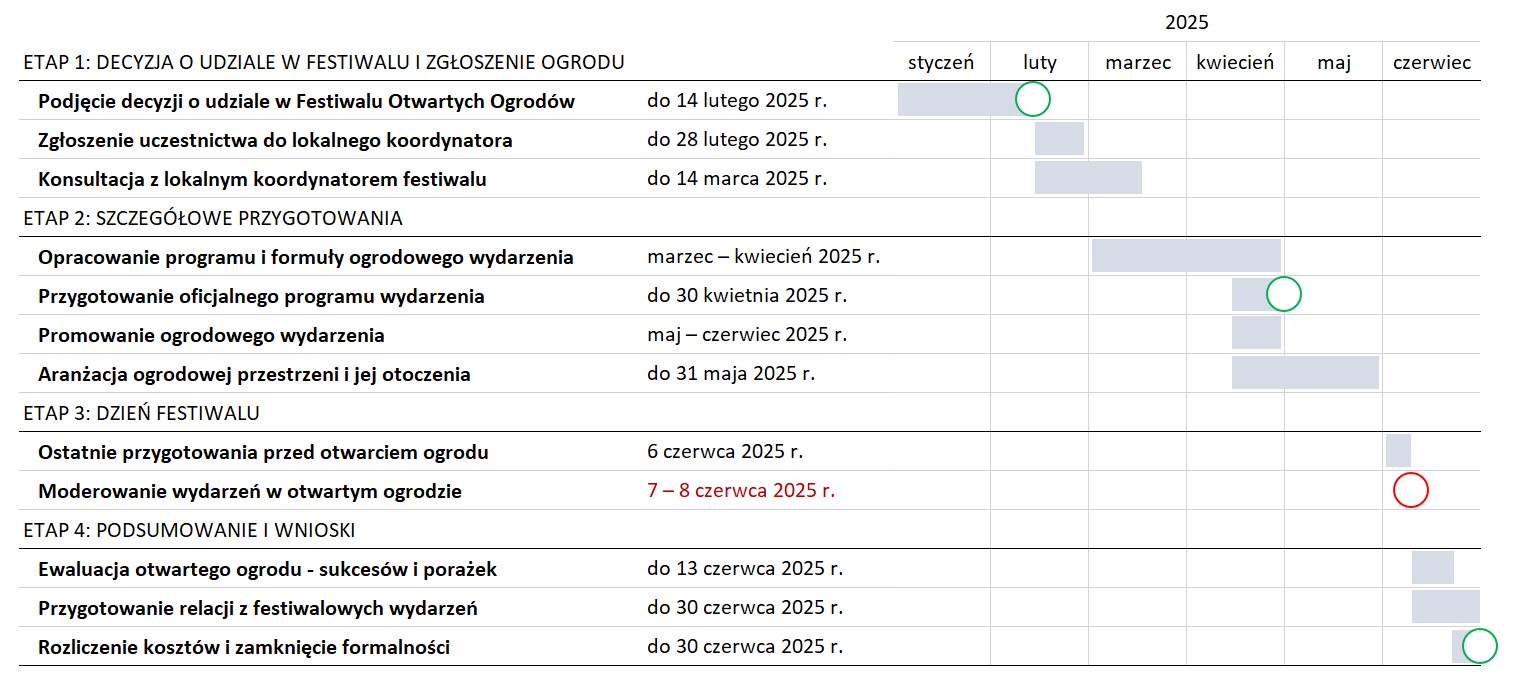
An essential aspect of the local coordinator’s work is their relationship with the central coordinator of the Open Gardens Program.[10] It is the central coordinator who oversees all program activities nationwide and ensures that implemented projects, including the Open Gardens Festival, align with its mission and principles. The local coordinator should maintain regular contact with the central coordinator, consulting key decisions regarding festival organization (especially program content) and reporting on its progress. This allows for the monitoring of festival projects as well as their support and promotion at a broader level. The cooperation between coordinators is formalized through appropriate agreements or licensing contracts, which define the terms of using the Open Gardens brand and the obligations arising from participation in the program.
A local coordinator can be an individual with the appropriate organizational skills and knowledge of the local community. It can also be a public institution, such as a cultural center, museum, or library, as well as a social organization (registered or unregistered) working to preserve historical, cultural, or natural heritage. In some cases, this role may also be fulfilled by another entity, such as a company, provided it has the necessary experience and resources required for organizing and coordinating such project initiatives.[11]
An important aspect of the local coordinator’s work is also ensuring the quality of organized events and their alignment with the goals of the Open Gardens program. They must oversee the festival’s implementation according to the established program standards, as well as monitor compliance with safety regulations and environmental protection guidelines. Additionally, the coordinator is responsible for encouraging residents to participate in the festival and fostering an atmosphere of engagement and friendly collaboration.
The role of the local coordinator of the Open Gardens Festival comes with great responsibility but also offers significant satisfaction through the opportunity to make a tangible impact on the cultural and social development of their community. Cooperation with the central coordinator and various partners enables the effective implementation and continuous growth of the festival while strengthening local identity and building meaningful interpersonal relationships.
The beginnings of the Festival: overcoming distrust
Magdalena Prosińska and Łukasz Wilmann, as pioneers of this initiative, had to face skepticism, break mental barriers, and inspire residents to open their private spaces to strangers. Their involvement was not limited to organizing cultural events—their primary goal was to build neighborhood bonds and encourage dialogue on important local issues. Preparing the first pilot edition of the Open Gardens Festival in Podkowa Leśna required eight months of intensive work. They were leaders of a significant social change, a role that always comes with natural resistance and numerous challenges. In this case, the task was particularly demanding—not only due to the innovative nature of the project but also because of its essence, which involved taking the risk of opening private spaces to the wider public.
The first stage required adapting the European concept of open gardens to a Polish context, creating regulations, developing visual identity elements, and establishing funding principles. The next step was planning the organization and logistics of the entire event. Another crucial challenge was spreading awareness of the festival idea and convincing residents to participate, both as audience members and as hosts of festival gardens. This required multiple visits to dozens of private homes, overcoming initial distrust, and encouraging homeowners to open their spaces. Thanks to the determination of the organizers and the openness of the Podkowa Leśna community to new initiatives, this effort succeeded. Many participants from the festival’s early editions continue to open their gardens to this day.[12]
An essential aspect of this first endeavor was securing support from influential public institutions. Their organizational experience and authority provided valuable assistance in developing the project. Among the partners were the European Heritage Days program, the Podkowa Leśna City Hall, the Podkowian Association, and many distinguished residents of Podkowa Leśna.
The program of the first edition of the Open Gardens Festival included a conference featuring Polish and international experts in urban planning, city revitalization, monument preservation, and urban greenery. Specialists from Hellerau, New York, and Kraków—Misia Leonard, Katrin Schulze, Danuta Glondys, and Krzysztof Skalski—came to Podkowa Leśna. Their workshops focused on issues such as the revitalization of the historic Jókawa Villa[13] and the City Park[14], as well as the development of a Municipal Information System.[15]
Funding for the first festival project came 75% from external sources. The resources for its implementation, mainly grants, remained at the disposal of the Podkowa Leśna City Hall in the following years as well.[16] Additional support was provided by sponsors and donors. The festival project’s budget was allocated to organizational, promotional, and logistical activities related to preparing and running the event.
The Open Gardens Festival quickly gained popularity, attracting more participants and inspiring other towns to join the initiative. The event expanded to a nationwide scale. Over the past twenty years, several new locations have joined the festival, including Zalesie Dolne, Komorów, Józefów, Warsaw (Sadyba and Włochy districts), Konstancin-Jeziorna, and Nałęczów. Each of these places contributes its unique character to the festival, adapting its format to local traditions and needs.
A space for free culture and private patronage
The Open Gardens Festival is an event that stands out among other cultural initiatives primarily because it is based on the active participation of the local community. The residents—garden owners, artists, craftsmen, and enthusiasts—are its main creators and hosts. As a result, the festival is not an externally imposed spectacle but a living, organic process in which culture develops from the grassroots, in line with the authentic needs and aspirations of the participants. This kind of co-creation restores a sense of agency and fosters a true community built on dialogue and mutual respect.
One of the festival’s key features is the revival of the idea of private patronage, which has historically been a cornerstone of cultural and artistic development.[17] By inviting artists into their private spaces, garden owners support their creativity in a natural and direct way—providing venues for exhibitions, concerts, workshops, and literary meetings. This model differs from one where culture is dictated by state institutions or corporate sponsors. Unlike commercialized or centrally funded events, the festival thrives on genuine human connections and a shared sense of responsibility for cultural enrichment.
Another essential aspect of the Open Gardens Festival is its detachment from ideological narratives, which often distort the true essence of culture and art. In today’s world, there is increasing pressure to embrace aesthetics and themes inspired by modern art that frequently deconstruct traditional values, promoting chaos, provocation, and content disconnected from historical identity rather than beauty and harmony. The festival offers an escape from this trend, creating a space for art rooted in local tradition, inspired by history and nature. Its value is judged by an uncoerced audience, guided by authentic admiration, aesthetic sensitivity, and an innate appreciation of beauty.[18]
Moreover, this event restores art to its original function—it is meant to inspire, foster a sense of community, and influence human sensitivity, rather than serve as a tool for propaganda or the deconstruction of established aesthetic norms.[19] Participants of the festival have the opportunity to engage with authentic creativity—born from passion and the desire to share beauty—rather than art forced to conform to mainstream trends. Significantly, the Open Gardens Festival also provides a platform for artists who, for various reasons, are not promoted by state cultural institutions. Their works often do not align with prevailing artistic canons or the ideological guidelines of dominant decision-making centers, making it difficult for them to find opportunities to showcase their work. Thanks to the festival’s openness and independence, these artists can reach an audience that values art free from imposed restrictions. The value of the Open Gardens Festival thus lies not only in promoting local traditions and strengthening neighborly bonds but also in creating a space for genuine grassroots culture—one that escapes commercial and ideological manipulation.
Is it worth getting involved?
Getting involved in the Open Gardens Festival is a great opportunity to co-create a unique event that brings together culture, art, science, and local traditions. Participating in the festival—whether as an organizer, garden host, or guest—allows for the exchange of ideas, experiences, and passions with like-minded individuals. It is also a chance to discover inspiring places that are usually inaccessible and to take part in unique artistic, educational, and community events. The festival creates a space for building relationships and strengthening neighborhood bonds. By getting involved in the festival, you:
- Create something unique;
- Share your passion, art, or craftsmanship;
- Invite neighbors to interesting workshops in your garden or studio;
- Meet fascinating people and build valuable relationships;
- Strengthen the sense of community and security;
- Help local history, tradition, and culture flourish;
- Revitalize your town and bring positive energy;
- Offer something meaningful to others.
For those open to new experiences and eager to actively participate in the cultural life of their community, the Open Gardens Festival is a unique opportunity to develop interests and engage in activities for the common good. It is also a way to promote the ideas of harmonious development, environmental protection, and care for the space we live in. With a variety of participation options, everyone can find something for themselves—from organizing literary meetings and exhibitions to hosting workshops, concerts, or simply opening their garden to visitors. Taking part in the festival brings not only the satisfaction of being part of a larger initiative but also the chance to leave a lasting impact on the life of your local community.
How to organize your open garden?
Deciding to open your garden to friends, acquaintances, and the wider public requires careful planning and execution. The typical steps include: registering your garden with the local coordinator, developing an event program, promoting your open garden, preparing and hosting the event, and finally summarizing and closing it.
1. Developing the Program and Registering Your Garden for the Festival
In the first quarter of the year, preferably within the designated registration period, you should declare your intention to organize an open garden to the local coordinator and establish the details of your participation. When registering your garden for the festival, you must define its theme and the content and form of the program. The presentation format of your garden may serve as:
- an artistic space – for exhibitions or concerts,
- an educational garden – hosting gardening, floristry, painting, handicraft, or culinary workshops,
- a historical site – featuring stories of family traditions or guided walks through historical areas of the neighborhood,
- an integration space – organizing picnics with games, contests, and entertainment.
For inspiration, you can look at festival programs from cities that have been organizing Open Gardens for many years.
2. Creating a Detailed Plan
An open garden should offer more than just sightseeing and admiring garden arrangements. It is worth preparing additional attractions and activities that will engage festival visitors. A crucial aspect is scheduling events so that they do not overlap with attractions in other gardens. This is an essential task in planning the overall festival program. A well-structured festival schedule should allow guests to visit as many open gardens as possible.
3. Promoting Your Open Garden
Promotion should start with writing a short text that will be used in festival materials. The text should include: the name (theme) of the garden, a brief description of the attractions, opening hours, the address and directions. Festival coordinators often print maps with event descriptions and promote them through media channels. However, it is recommended to independently promote your garden—among neighbors and friends, on social media, through printed flyers, or via email.
4. Preparing the Garden for Opening
The garden should be both aesthetically pleasing and safe. Clean outdoor furniture, trim plants, remove weeds, and tidy up pathways. Check for potential hazards, such as sharp objects or slippery surfaces. If the event is scheduled to continue after dark, ensure proper lighting. Provide enough seating—benches, chairs, or picnic mats. Ensure visitors can move freely and comfortably. Clearly mark the garden in public space with a poster, signs, or banners for easy identification. Checklists with tasks and assigned responsibilities can be extremely useful during the preparation process.
5. Managing Events on the Festival Day
On the day of the event welcome visitors. Set up an information point at the entrance with event programs or leaflets. Offer refreshments providing water, tea, coffee, cookies, or small snacks creates a welcoming atmosphere. Ensure smooth execution assigning people responsible for handling logistics (microphones, sound systems, projectors, lighting etc.). Collect feedback by seting up a guest book or survey where visitors can share their impressions. Show appreciation – thank all guests and those who helped organize the event.
6. Closing and Summary
After closing the garden reflect on what was successful and what could be improved for the future. Calculate all costs and consider ways to optimize them for the next edition. Prepare a written, photographic or video report of the event. Share the event summary with the local coordinator and promote it online, on social media, forums, or among friends and family.
Key Success Factors for an Open Garden Festival
- Engagement – The garden owner, guests, and the local community should actively and enthusiastically participate in the event.
- Unique character – An original and engaging garden program.
- Good organization – A detailed plan and well-prepared garden space.
- Effective promotion – Reaching a broad audience to maximize attendance.
Festival means: Tradition, Community, and Culture
The Open Gardens Festival is a unique initiative that dates back to 2005 when it was first organized in Podkowa Leśna as part of the European Heritage Days. Since then, the event has grown, encompassing more towns and creating a network of local festivals. Its organization is part of the broader Open Gardens program, which promotes the idea of making private spaces accessible for cultural, artistic, and social activities.
The festival brings significant benefits to local communities by creating a space for integration, exchange of ideas, and the collective discovery of cultural heritage. Thanks to this initiative, both residents and visitors can not only admire the beauty of open gardens but also participate in concerts, exhibitions, lectures, and other events that bring local culture to life. It is also a return to the tradition of free culture and private patronage, where enthusiasts of history, culture, art, science, and many other fields share their knowledge and creativity in an intimate garden setting.
However, organizing the festival requires efficient coordination and close collaboration between local festival organizers, the central program coordinator, and their partners. Proper planning, logistical support, and event promotion are essential. Key roles in festival preparations are played by cultural institutions, local governments, social organizations, and the hosts who open their gardens to the public.
Engagement in the Open Gardens Festival is not just an opportunity to participate in a unique event but also a chance to co-create a space where culture, art, nature, and social involvement come together in harmony. It is an occasion to become part of an active community that nurtures local heritage and builds a future based on openness, dialogue, and cooperation.
Tomasz Domański
Owczarnia, Podkowa Leśna, 2025
Film reports
Footnotes
[1] The first Open Gardens Festival took place in September 2005 in Podkowa Leśna, coinciding with the celebration of the city’s 80th anniversary. The initiators and originators of this event were Magdalena Prosińska and Łukasz Willmann. Their goal was to highlight the beauty and value of the local cultural heritage while fostering the integration of the Podkowa Leśna community. The festival was born out of the need to preserve the cultural heritage of the pre-war garden city, created according to Ebenezer Howard’s concept. For this reason, its first editions were held as part of the European Heritage Days. In the following years, this initiative was embraced by other garden cities near the capital, leading to the expansion of the festival’s formula to additional locations beyond the Warsaw region.
[2] A “program” is a broad, long-term initiative that encompasses a series of interconnected activities and projects aimed at achieving common strategic goals. It is a flexible framework that allows for the implementation of various projects tailored to local conditions and needs. In contrast, a “project” is a single, time-limited activity with clearly defined objectives, resources, and a schedule. A program may consist of multiple projects that collectively contribute to its overarching objectives. The Open Gardens Program includes long-term activities promoting culture, national heritage, and social engagement. Meanwhile, the Open Gardens Festival is a project within this program—a recurring event organized in different locations according to established rules and standards.
[3] Magdalena Prosińska, Otwarte Ogrody, Kultura Enter nr 10, May2009 (link); Biuletyn Miasta-Ogrodu Podkowy Leśnej nr 12, March 2005 (link); Biuletyn Miasta-Ogrodu Podkowy Leśnej nr 15, September 2005 (link)
[4] Commercial ventures are profit-oriented activities operating within a business framework, where success is measured by financial indicators such as revenue or customer numbers. In contrast, non-commercial ventures, such as the Open Gardens Festival, focus on social, educational, and cultural values, promoting community integration and local heritage. Organized by public institutions, non-governmental organizations, or residents, these initiatives are funded through grants, subsidies, and sponsorships. Their goal is not profit but openness and accessibility to a broad audience.
[5] Open Gardens Festival 2024 Program in Konstancin-Jeziorna (link)
[6] Open Gardens Festival 2024 Program in Nałęczów (link)
[7] Tomasz Domańskie, Program Otwarte Ogrody, author’s blog, Owczarnia-Podkowa Leśna, 2025 (link)
[8] Stowarzyszenie Sąsiedzkie Włochy (pl. Neighborhood Association Włochy), Festiwal Otwarte Ogrody (link)
[9] An interesting example could be the Transboundary Gardens of Experience project, aimed at schools, educational institutions, and research centers in border regions. It offers Polish-German educational workshops in scientific institutions as well as summer camps. (link)
[10] The central coordinator of the Open Gardens Program is its author, Magdalena Prosińska. She oversees the implementation of the Program at the national level, coordinating the efforts of local festival organizers as much as possible. Her main focus is ensuring that events comply with the Program’s standards and promoting the Festival on a nationwide scale. She also serves as an advisor, supporting local coordinators in planning and executing festival initiatives. The formal collaboration between the central coordinator and local festival organizers is governed by agreements or licensing contracts that define the terms of participation in the Program. See: Regulations of the Open Gardens Program, ed. M. Prosińska, March 1, 2025. (link)
[11] The role of the local coordinator of the Open Gardens Festival can be fulfilled by cultural animation and education centers, local action groups (LAGs), city and regional heritage societies, foundations and associations, informal resident groups, enterprises, as well as research institutes and universities. The key requirement is that their activities align with the goals of the Open Gardens Program and that they can effectively collaborate with local and supra-local festival partners. See: Regulations of the Open Gardens Program, ed. M. Prosińska, March 1, 2025. (link)
[12] Magdalena Prosińska, Podsumowanie współpracy 2004-2011, Fundacja Dziedzictwo dla Przyszłości (pl. Heritage for the Future Foundation), Podkowa Leśna 2011
[13] Villa “Jókawa” is a historic building featuring unique architectural elements, located at 19 Parkowa Street in Podkowa Leśna. Built in 1928, it was transported in parts from Volhynia along with the neighboring villa “Przedwiośnie.” Both villas were constructed from larch wood, ensuring their durability over the years. In the past, Villa “Jókawa” served as a guesthouse, hosting gatherings and cultural events. However, its current technical condition prevents such events from taking place. In 2023, efforts were made to combat pests damaging the villa’s wooden structure. The villa remains a distinctive element of Podkowa Leśna’s architectural heritage. (link)
[14] The Historic Municipal Park in Podkowa Leśna is a significant urban element of this garden city. The park’s concept was developed between 1925 and 1926 based on a design by Kazimierz Mikułowski. It was planned as the central part of the settlement, intended to combine recreational, aesthetic, and social functions in line with the idea of harmonious coexistence between humans and nature. Its layout was inspired by Baroque garden designs, reflected in its axial spatial arrangement and the grand avenues leading to the “Kasyno” Palace building. Over the years, the park has served as a gathering place for residents and a venue for cultural events, continuing the tradition of open spaces that integrate the local community. In 1981, it was placed under conservation protection and entered into the register of historic monuments as two separate areas: the garden by the Palace and the town’s central greenery. Despite the passage of time, the park remains one of the most distinctive elements of Podkowa Leśna, preserving its unique urban and natural heritage. Compare: M. Gmiter, The History and Significance of the Historic Park in Podkowa Leśna, Bulletin No. 3(96), June 2021, pp. 6-7. (link)
[15] LMNT design & direct, System Informacji Miejskiej w Podkowie Leśnej (pl. Urban Information System in Podkowa Leśna) (link)
[16] Magdalena Prosińska, Podsumowanie współpracy 2004-2011, Fundacja Dziedzictwo dla Przyszłości, Podkowa Leśna 2011
[17] The history of patronage dates back to ancient times. The term “patronage” originates from the name of Gaius Cilnius Maecenas (c. 70–8 BCE), an advisor to Emperor Gaius Octavius Augustus (63 BCE–14 BCE), who supported poets such as Horace and Virgil. During the Renaissance, patronage reached its peak when powerful families, such as the Medici in Florence, financed artists like Leonardo da Vinci and Michelangelo. In the 19th and 20th centuries, the role of patrons was also taken over by foundations and philanthropic organizations, such as the Rockefeller Foundation and the Carnegie Foundation.
[18] Ideological narratives often distort the true essence of culture and art, subordinating them to political, social, or commercial objectives. In the 20th century, examples included socialist realism in the USSR and Nazi propaganda art, both of which imposed specific themes and aesthetics on creators, eliminating artistic freedom. Today, culture is sometimes used as a tool of social engineering, for instance, through radical deconstruction of tradition or the subordination of art to ideological narratives. Another issue is commercialization, which reduces art to mass entertainment devoid of deeper value, as well as censorship driven by political correctness, leading to the exclusion of creators and the removal of classic works. True culture should remain a space for free expression and reflection, not a tool for achieving short-term ideological goals.
[19] Art has always played an inspiring role, stimulating reflection and fostering human connections, allowing successive generations to discover universal values and develop sensitivity. However, when it is subordinated to ideologies and reduced to a tool of propaganda, it loses its authentic character, becoming an instrument of manipulation rather than a source of spiritual enrichment. Similarly destructive is the radical deconstruction of aesthetic norms when it does not arise from the natural evolution of art but serves merely as a deliberate negation of tradition. The evolution of creativity is a natural process, but when its primary purpose becomes the constant undermining of existing values, it leads to cultural depletion. True art does not divide or destroy; rather, it creates a space for dialogue in which individuals can find both answers to fundamental existential questions and a sense of connection with others.
© Copyrighted material – all rights reserved.
Copying without the author’s permission is prohibited.
If needed, please contact me.