Pacta sunt servanda!

The first mobile telephony networks, i.e. 1G ( 1st Generation ), were created at the turn of the 1970s and 1980s, although the idea appeared in the laboratories of the Bell Telephone Company as early as the 1940s. The first commercial mobile telephony services were offered in the 1980s., using several competing analog technologies. Two of them gained the greatest popularity: the Scandinavian system NMT (Nordic Mobile Telephony System) and the American AMPS (Advanced Mobile Phone System), known in Europe as TACS (Total Access Communication System).
In addition to the obvious advantage, i.e. mobility, 1G telephony had significant disadvantages limiting its wide spread. Users had to take into account a low level of security (risk of eavesdropping), lack of data transmission and international roaming, as well as lack of network compatibility, low efficiency, limited territorial coverage, heavy terminals with weak batteries and high costs of using that telephony. Due to its limitations, none of the 1G networks in the world has achieved a market penetration level above 5%.
The fastest development of the 1G telephony was observed in the 1990s in Finland and Sweden. The first Polish mobile network was launched in 1992 by PTK Centertel. The same like in the Scandinavian networks, it used the NMT technology. After introducing to Poland 2G mobile telephony, the PTK Centertel changed the name of its network to Idea and focused on developing services in the GSM system. In the following years, after its ownership changes, the company also changed its name to Orange Polska.
The Dyna Motorola TAC 8000X analog telephone was the first portable terminal offered in 1G telephony. The mass production of this device began in 1983. The first copies went on sale in the following year. The interest in this phone, as well as in mobile telephony, was huge at that time.

2G telephony was established in Finland in 1991. Its essence was digital transmission, which, compared to analog 1G networks, allowed to increase network capacity and range, increase flow stability, improve call quality, reduce the negative impact of telephones on health, and introduce new services such as SMS, mobile Internet access, fax, teleconferencing and subscriber identification by SIM card.
2G telephony used GSM (Global System For Mobile Communications) technology. It was originally intended to serve in twelve EEC (European Economic Community) countries, but soon appeared in over two hundred countries. Polish GSM900 networks were established in 1996. Their operators were Polska Telefonia Cyfrowa (Era GSM) and Polkomtel (Plus GSM). In 1998, PTK Centertel (Idea GSM) joined them, using the GSM1800 (DCS) technology. In the second half of the 1990s, GPRS and EDGE technologies appeared as extensions to the GSM standard. Their implementation was defined as 2.5G and 2.75G telephony.
GPRS was the most commonly used standard for mobile data transmission, providing a speed of 30-80 Kbps. The SMS service (160 characters) created the basis for the MMS service offering the sending of long texts and multimedia files. The EDGE technology, also known as EGPRS, offered a transfer speed of 296 Kbs, which enabled the implementation of such the services as: access to e-mail and intranet, surfing the Internet, using multimedia services and simple games, using the telephone as a modem or Internet messenger, and also for streaming video and using localization tools.
The first phone supporting the GSM standard was the Nokia 1011.
UMTS technology was the first technical standard that assumed the possibility of full access to the Internet in mobile networks. UMTS treated voice and data transmission equally. It was developed as a system integrating all telecommunication systems – ICT, radio and television. 3G networks offered the ability to make voice calls, video calls, send text messages and transfer data.
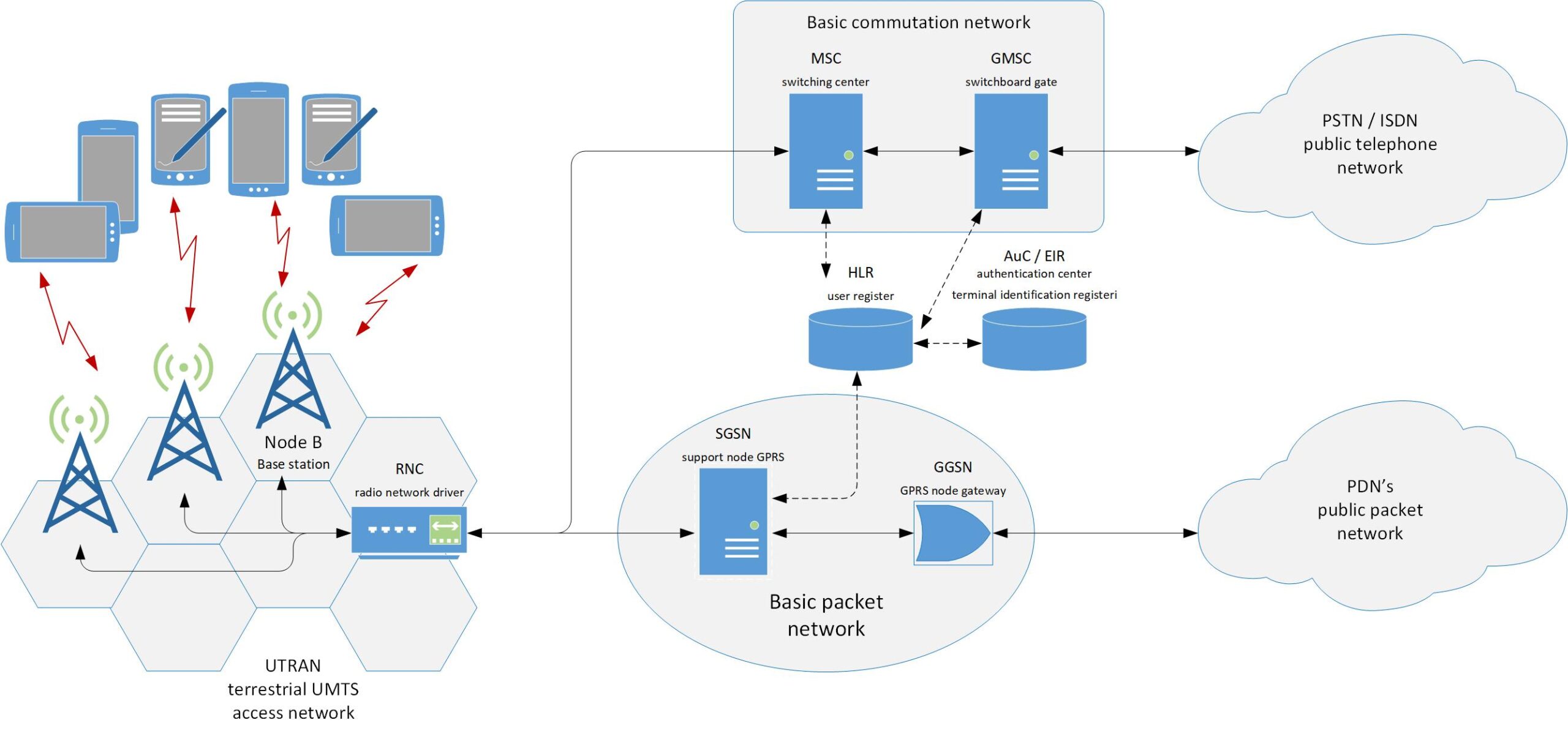
UMTS technology was conceived as an extension of the 2G network. Many elements of both networks remained common, e.g. digital switchboards for establishing voice calls (MSC). The backbone network remained unchanged , but a new radio access network (UTRAN) with a WCDMA interface was needed. Smaller cells required multiple base stations (NodeB), different from BTS stations in GSM networks. 2G and 3G networks could work together. The development of the 3G network had a significant impact on fixed-line telephony services, which began to lose their popularity.
However, UMTS technology did not turn out to be as revolutionary as originally assumed. The capacity of the network was quickly depleted as the number of users who needed constant, wireless access to the Internet grew. High license fees and the costs of expanding the 3G infrastructure meant that dreams of creating a platform connecting people, computers and other devices did not come true. It turned out that the forecasts regarding profits from 3G telephony were greatly exaggerated. It was assumed that the so-called killer application bringing high revenues will be Videocall. However, market interest in this service turned out to be negligible.
3G networks based on UMTS technology offered transfer speeds of up to 386Kbs. The use of HSDPA and HSUPA technologies (software modifications in base stations and controllers) made it possible to increase the transfer rate to 14.4 Mbs, and thus increase the network capacity and resistance of radio transmission to atmospheric disturbances. Such upgraded networks were referred to as 3.5G.

4G telephony is the next stage in the evolution of mobile telephony, enabling wireless data transmission at an average speed of 225 Mbs. The first commercial 4G network was launched in 2009 in Scandinavia. The main difference between 3G and 4G networks is speed. The basic advantages of the 4G network are: fast transfer without downtime and interference (ten times faster response time compared to 3G), improved radio interface, packet switching on the IP protocol and a simplified structure of the backbone network.
The implementation of LTE enabled access to advanced multimedia services and online games, but it was associated with the need to incur significant costs for the modernization of the radio interface and the replacement of telephone sets. The LTE air interface uses OFDM for downlink transmission and SC-FDMA (DFTS-FDMA) for uplink transmission . This is one of the most visible differences from UMTS technology, which is based on the WCDMA interface.
The 4G cellular network uses the aggregation of radio bands, which allows for a greater range and support for more devices, as well as the operation of one receiving device (smartphone, modem) on several frequencies simultaneously. The quality of using the 4G network is determined by the distance from the transmitter, terrain, parameters of the receiving device, as well as the number of active users connected to the same base station.
About 99.8% of the population of Poland is within the reach of the 4G network. Increasing the capacity of the network is carried out, among others, through the so-called refarming, i.e. the use of frequencies that support 3G over 4G networks. Increasing the speed and capacity of the network made it possible to connect to wireless data transmission not only smartphones, but also TV sets, refrigerators, cleaning robots and smartwatches.

The first Polish 5G networks were launched in 2020. They operate on a similar principle to 2G, 3G and 4G networks. The difference lies in the way the radio frequencies are used in the three bands (3.4-3.8 GHz, 700 MHz, 24.25-27.5 GHz). Their full implementation will allow for data transfer counted in gigabytes per second, i.e. at a speed comparable to fixed fiber optic networks. 5G networks are characterized by increased capacity, allowing for the simultaneous operation of many devices of various types, which in practice means the implementation of the concept of the so-called Internet of Things, development of Smart Cities and Virtual Reality.
The IMT-2020 standard established by the International Telecommunications Union (ITU) defines the requirements for 5G networks with downlink speeds of up to 20 Gbs and uplink speeds of up to 10 Gbs. This will enable access to high speeds also for stationary users, with the ability to support 1 million devices per 1 square km. It will be possible to download files ten times faster than in 4G networks, stream video in 4K-8K resolution, use cloud games, as well as many applications in urban infrastructure control and medicine. It is estimated that 5G infrastructure will be the driving force of the The Fourth Industrial Revolution.
5G networks coexist with and complement 4G networks. They use the Dynamic Spectrum Sharing method, based on the dynamic allocation of radio resources between the two networks, depending on the current needs of the user. When establishing a 5G connection, the user connects to the 4G network to provide control signaling and to the 5G network to enable faster connection and increase the capacity of the 4G network.
The high density of base stations in 5G networks, as well as the use of microwave radiation, raises many concerns about the negative impact on human health. There are also concerns about subjecting people’s lives to complete surveillance and control by electronic systems. Many scientific studies show links between radio radiation in mobile networks and diseases. Reservations have been made to the WHO and the UN, among others .
Another wireless communication system will be 6G networks operating at higher frequencies than 5G networks (100 GHz-3THz). This will enable data transmission at speeds of about 1 Tbps, as well as much higher throughput. The share of artificial intelligence and cloud solutions will increase in the 6G system. They are supposed to be a combination of the physical world with virtual reality and biological organisms. 6G is projected to remain the main mobile communications technology around 2030-2035.