Pacta sunt servanda!
Training and consulting for public administration
Support for local government units
I conducted training and consulting activities for local government units mainly in cooperation with the Municipal Development Agency (MDA) in Warsaw. At the same time, I was actively participating in the public affairs of my local government community, performing the duties of a city and a county councillor. When starting cooperation with MDA, I already had practical experience related to the creation of municipal self-government structures and the organization of the Regional Accounting Chamber in Łódź.
MDA played a significant role in creating and providing the newly established municipalities with professional knowledge in the field of management. Thanks to foreign support, MDA specialists transferred the best practices borrowed from countries with mature structures of local government and administration to the realities of local government. Local governments and market economy mechanisms were a novelty in post-communist Poland. The methodological solutions developed by MDA were implemented in the daily consulting practice of MDA specialists, and also popularized at national and international conferences (InvestCity, EuroCity, Eastern Wall Congress, Partnership Program for Local Government, International Citi/County Management Association and many others).
Local development in the perspective of the state political reform
The table of contents of this brochure reflects the program of extensive training, repeatedly presented to Polish municipalities, as well as at domestic and foreign fairs and conferences. The training program was of a very practical nature. It was addressed to municipal councilors and top management in local government units. It presented a set of interrelated tools in the field of strategic management, starting with analyzes of the state of the municipality, and ending with the implementation of public investments.
The training was one of the elements of consulting services provided by MDA to the municipalities. Their goal was to introduce councilors and managers of municipal units to the issues of professional management in the context of the ongoing systemic changes and the need to stimulate sustainable local development.
TQM in the municipality, i.e. quality management in public administration
TQM training was aimed at introducing representatives of municipal organizational units to the issues of management and work quality, which had a direct impact on the efficiency and cost of providing public services. A city residents expect high-quality services at the lowest possible prices. The prices of services depend on many cost components, which are controlled to a greater or lesser extent by the local government administration and municipal services. One of the cost elements, fully dependent on the municipal authorities, is the efficiency of public services.
Implementation of the principles and techniques of TQM (Total Quality Management) should be a constant task in everyday local government practice. Competences in this field should be systematically disseminated at all levels of management and in all areas of the commune’s activity, because the quality of public services is the sum of the quality of work at each individual job.
Private-public partnership in the municipal services sector
Achieving an improvement in the quality of life of local communities depends to a large extent on the condition and efficiency of management of municipal technical infrastructure systems. Its functioning directly affects the scope and quality of satisfying the basic needs of the inhabitants, and also determines the possibilities of developing economic entrepreneurship in the commune. The need to restructure the municipal economy was one of the main challenges for the new local government administration on the way to achieving a higher standard of living for local communities, comparable to the European Union countries.
The article presented here indicates the issue of privatization of municipal services, focusing on presenting the essence and several variants of the most common forms of private-public partnership. Training in this field was aimed at introducing Polish local government officials to basic organizational, economic and legal issues related to entrusting public tasks to private entities.
Information and communication systems in the area of the capital city of Warsaw
The document presented here is a working study that served as the source material for the preparation of the report on the state of the capital city of Warsaw, in its part concerning the state and prospects for the development of information and electronic communication systems. Its content focuses on the development of the information society and electronic administration. The study does not exhaust the subject, but indicates the most important problem areas. Detailed issues are presented against the background of comparative issues and in the light of programming documents of the European Union and their Polish equivalents. An important part of the report are theses regarding the positive and negative phenomena occurring in the described field, as well as recommendations regarding the directions of further strategic actions. Much more space has been devoted to the service layer than the technical one, because the presentation of electronic services is more important in the strategic planning process than specialized descriptions of the technical parameters of communication technologies. Technology is only a means to an end, not an end in itself.
The principle of subsidiarity defining the criteria for the vertical division of power structures states that a higher unit should never be entrusted with what a lower unit can equally well do. Responsibility for public affairs should be borne primarily by those authorities that are closest to the citizens.
European Charter of Local Self-Government
The scope of activities of the Municipal Development Agency in Warsaw
The Municipal Development Agency (MDA) was a State Treasury foundation established by the Minister of Finance in March 1995. Its activities served to support Polish municipalities in the creation of efficiently managed local government structures, and in particular – in professional and responsible management of public finances. MDA’s tasks included carrying out activities aimed at developing and disseminating systemic solutions allowing for making rational decisions and efficient management of municipal property.
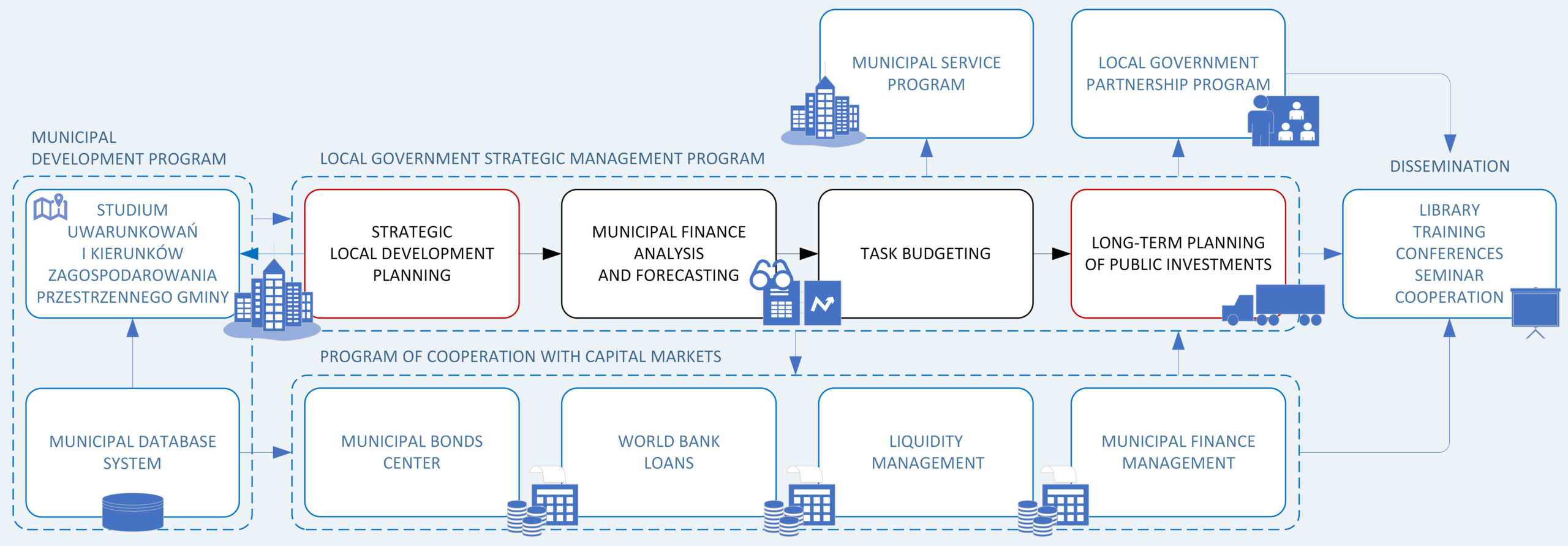
Thanks to cooperation with experts in the field of strategic management, financial management, municipal management, as well as drawing on the experience of foreign local government environments, MDA has developed a unique system of municipal management that has been successfully applied in many cities. The center of this system were tools and methodological solutions in the field of strategic planning of local development; analyzes of the state and forecasting of public finances; performance budgeting and long-term investment planning.
Beneficiaries of programs run by the Municipal Development Agency
The following communes, among others, participated in the programs conducted by MDA: Biała Podlaska, Białystok, Biskupiec, Bisztynek, Bochnia, Ciechanów, Cisna, Dąbrowa Górnicza, Głuchołazy, Gołdap, Gorzów Wielkopolski, Kalwaria Zebrzydowska, Kamieńsk, Kętrzyn, Kielce, Kosów Łącki, Kraków, Krupski Młyn, Kutno, Legionowo, Legnica, Limanowa, Lipnica Wielka, Lisewo, Lubartów, Łasin, Łódź, Michałowice, Mierzęcice, Olsztynek, Orneta, Ostrów Wielkopolski, Pobiedziska, Raciąż, Reda, Reszel, Rzepin, Sępólno Krajeńskie, Siedlce, Solec Zdrój, Sosnowiec, Szczecin, Sulejówek, Śrem, Świdnica, Teresin, Tuchola, Wałbrzych, Wiązowna, Wieliszew, Woźniki, Wrocław, Zawoja, Zgierz, Zielona Góra and Ziębice.